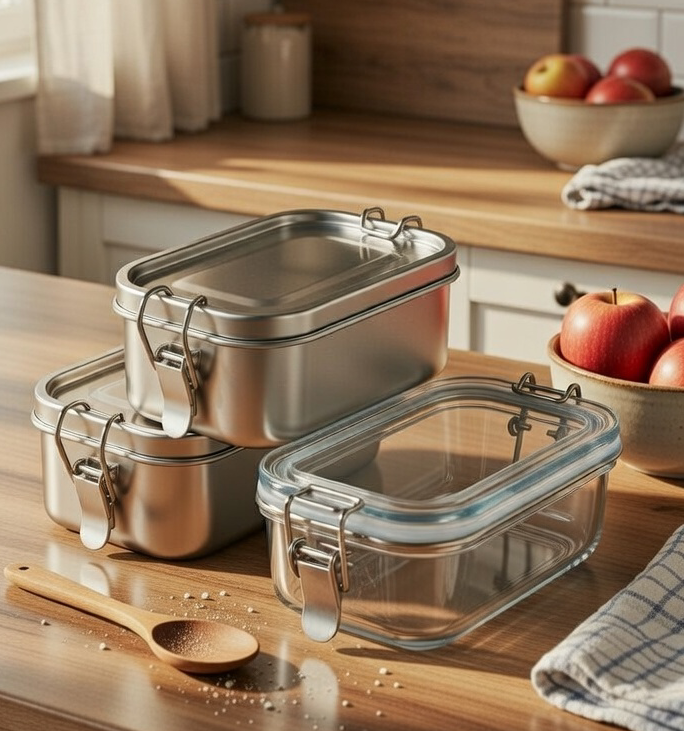
Choosing the right food storage material can influence durability, convenience, and potential exposure to unwanted substances. While plastic containers are widely used, many people consider glass or stainless steel as alternatives.
Both materials are commonly recommended for reducing plastic contact with food. However, each comes with practical advantages and limitations depending on how they are used. If you are looking for a broader overview of reducing microplastic exposure at home, you can start with our general guide on practical reduction strategies.
This guide compares glass and stainless steel food storage in terms of safety, durability, maintenance, and everyday practicality.
Why Food Storage Material Matters
Food storage containers come into repeated contact with meals, leftovers, and beverages. They are often exposed to heat, refrigeration, freezing, and daily handling. Over time, these conditions can affect how materials perform and how stable they remain.
When evaluating alternatives to plastic, the main considerations typically include chemical stability, resistance to heat, durability, and long term practicality. The goal is not only to reduce plastic contact but also to choose materials that hold up well under normal kitchen use.
Understanding these factors makes it easier to compare glass and stainless steel objectively rather than relying on general assumptions.
Glass Food Storage: Pros and Limitations
Glass is often recommended as a replacement for plastic because it is non porous and chemically stable under normal kitchen conditions. It does not absorb odors, stain easily, or react with acidic foods. This makes it particularly suitable for storing leftovers, sauces, and prepared meals.
One of the main advantages of glass is its resistance to heat. Most tempered glass containers are safe for use in ovens and microwaves, provided they are designed for that purpose. This allows food to be reheated without transferring it to another container.
However, glass has practical limitations. It is heavier than other materials and can break if dropped. For households with children or for use outside the home, weight and fragility may be important considerations.
In addition, many glass containers use plastic or silicone lids to create airtight seals. While the food does not typically come into contact with the lid during storage, it is still a component to consider when evaluating overall plastic reduction.
Stainless Steel Food Storage: Pros and Limitations
Stainless steel is widely used in cookware and kitchen equipment due to its strength and durability. High quality stainless steel is resistant to corrosion, does not easily break, and performs well under regular handling.
Unlike glass, stainless steel containers are lightweight relative to their strength and are less likely to shatter if dropped. This makes them particularly practical for transporting meals, school lunches, and outdoor use.
Stainless steel is also stable under normal temperature conditions. However, it is not microwave safe, which limits reheating convenience compared to glass. Food typically needs to be transferred to another container before heating.
Another consideration is visibility. Unlike glass, stainless steel is opaque, so the contents are not visible without opening the container. For some users, this affects organization and convenience.
As with glass products, lids may contain silicone seals or plastic components to improve airtight performance. Evaluating these details helps assess the overall reduction in plastic use.
Glass vs Stainless Steel: Direct Comparison
When comparing glass and stainless steel directly, the differences become clearer in specific use cases rather than in overall safety.
In terms of chemical stability, both materials are considered stable under normal kitchen conditions. Neither is prone to shedding particles during regular use, and both reduce direct plastic contact compared to conventional plastic containers.
For reheating and oven use, glass has an advantage because it is microwave and often oven safe. Stainless steel cannot be used in a microwave, which adds an extra step when reheating food.
For durability and transport, stainless steel typically performs better. It resists dents and breakage more effectively than glass, making it suitable for packed lunches and travel.
In terms of weight, stainless steel is generally lighter and easier to carry, while glass provides the benefit of transparency, allowing users to see contents without opening the container.
Ultimately, the better choice depends less on theoretical safety differences and more on how and where the container will be used.
Which Option Is Better for Different Situations?
For storing leftovers at home and reheating meals, glass containers are often more convenient. Their microwave compatibility and transparency make them practical for daily kitchen use.
For packed lunches, commuting, and outdoor activities, stainless steel may be the more practical choice due to its durability and lower risk of breakage.
For freezer storage, both materials can perform well, provided they are designed for temperature changes. However, sufficient space should be left in glass containers to prevent cracking from expansion.
Households often benefit from using a combination of both materials depending on context rather than choosing one exclusively.
Final Recommendation Based on Use Case
Both glass and stainless steel offer meaningful reductions in plastic contact compared to conventional plastic containers. The decision between them is primarily practical rather than safety driven.
Glass is well suited for home use, meal preparation, and reheating. Stainless steel is often more convenient for transport, durability, and situations where breakage is a concern.
For many households, a mixed approach provides the most flexibility. Using glass for storage and reheating at home, and stainless steel for packed meals or travel, balances practicality with reduced plastic exposure.
Choosing durable, well constructed containers in either material is typically more important than selecting one material exclusively.
Leave a Reply to Are Silicone Lids Safe for Food Storage? – lowplasticlife.com Cancel reply